
Baptism and the Lord’s Supper
Most married couples have strong opinions about their wedding rings being worn at all times. This unspoken expectation exists from day one of wedding bliss to day 7,342 of nitty-gritty life together. No wedded person dares to abandon this age-old tradition without a viable, certainly well-rehearsed justification for not wearing that ring on their finger. (Okay, I might be exaggerating a little for fun, but it is essentially true.) Why do we put so much emphasis on wearing the wedding ring faithfully when the band itself is not what makes us married? Our wedding-day covenant with one another officially declares us “married,” yet we place so much importance on wearing the exchanged rings because they stand as lifelong symbols of commitment. The wedding ring symbolizes a devoted union between two people.
Similarly, the Christian life has two symbols of union with Jesus that He himself instructed us to practice. One is baptism, which communicates a person’s spiritual conversion to Christianity and celebrates his/her adoption into God’s eternal family. The other is the Lord’s Supper (also called “Communion”). The Lord’s Supper is a reverent practice for remembering Christ’s costly sacrifice on our behalf. These two symbols are called ordinances or sacraments. Like the wedding ring, they are understood and practiced as outward symbols of what has taken place spiritually within us.
Baptism
“Go therefore and make disciples of all nations, baptizing them in the name of the Father and of the Son and of the Holy Spirit,” (Matthew 28:19)
Baptism, which Jesus prescribed in Matthew 28:19, is the act of a new Christian convert being fully immersed in water by another believer. Baptism has been practiced in many forms and with varied meanings since Jesus gave us this command in Scripture. Some perceive baptism as a priest’s sprinkling over an infant. Others believe baptism is a necessary part of the salvation process, meaning a person is not wholly saved until their baptism is complete. In an effort to allow the Bible to define the mode and meaning of baptism, we pull back the lens on Scripture to take in a broader view. In doing so, the purpose of Baptism throughout biblical history takes on two distinctions.
First, the mode of baptism we see described in the New Testament is immersion, not sprinkling. The New Testament was written in Greek, so when we look at the original Greek word for baptize or baptism, we find “baptizo” and “baptisma,” respectively. Both words inherently imply complete submersion in water (Strong’s Concordance). In the same way that the modern English word “soaked” reveals a vivid, clear image for how wet something is, the original Greek words for baptism inherently imply complete submersion.
Not only does the original Greek provide a clear interpretation that points to immersion (not sprinkling) as the scripturally intended mode of baptism, but Romans 6:4 describes the symbolism of New Testament baptism as a picture of our old self being buried with Christ into death and our new self being raised into new life, similar to how Christ was buried and resurrected. This imagery only makes sense if baptism involves the complete immersion of a believer into a body of all-consuming water (buried with Christ) and the raising up out of it (raised to new life).
The meaning of baptism is another debatable topic among different denominations in the Christian faith. The baptism Jesus prescribes in response to an individual placing his/her faith in Christ’s atoning sacrifice is very special, but we must remember that it is only intended as a beautiful trademark for the promise of salvation that he made with us. John 3:16 states, “For God so loved the world, that he gave his only Son, that whoever believes in him should not perish but have eternal life.” God promised mankind that belief in Jesus is the key to receiving eternal union with God. Further, in the Old Testament, the prophet Isaiah stated in 28:16 that “whoever believes in him will not be put to shame.” And to pull the lens back even further, in Genesis 15:6 God counted Abraham’s faith, not his good deeds or obedient acts, as righteousness. Clearly, all of Scripture emphasizes that God’s character is consistently concerned with our faith, not our actions, when deeming us acceptable for eternity with Him. This foundational, permeating truth in Scripture must be so deeply rooted in us that we use it to discern any other parts of Scripture that may appear to confuse the matter at first glance. As we consider the purpose of baptism for a believer, we must not attach the act of baptism as a requirement to fulfill our salvation. It is our belief in Jesus’ sacrifice on our behalf that secures us for eternity. Baptism is simply an outward act of obedience in response to a saving faith in Jesus.
Further, Scripture identifies many consistencies in God’s character that point to His use of symbols for mankind. Maybe you are familiar with another sign God used in the Old Testament when He promised Noah He would never flood the entire earth again. God sent a rainbow and declared it as a symbol of His promise. A rainbow itself does not hold the power to restrain devastating floodwaters from the earth; that power only comes from God. The rainbow is simply a symbol for the promise. In a similar way, the baptism of a believer does not hold the power to transform a life; it symbolizes what God has already changed in the heart of a believer. Baptism illustrates the regeneration that took place when the person received the Holy Spirit upon salvation. Baptism is a response to salvation, not a requirement for it. Throughout all of Scripture, God makes it clear that faith determines right standing with God, not the disciplined act of baptism itself. If some verses seem to imply that baptism is part of a completed salvation process, we must use wisdom acquired by applying God’s entire character and the total context of Scripture to find the most accurate interpretation.
The Lord’s Supper
“And he took bread, and when he had given thanks, he broke it and gave it to them, saying, ‘This is my body, which is given for you. Do this in remembrance of me…This cup that is poured out for you is the new covenant in my blood.’” (Luke 22:19-20)
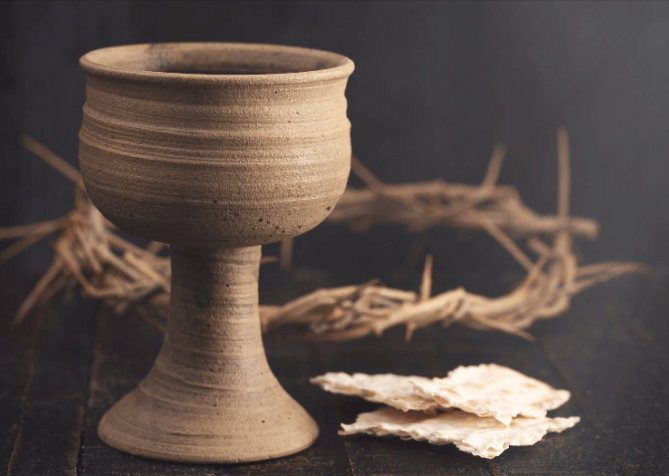
The Lord’s Supper is the other ordinance that Jesus prescribed for us as believers. In Luke 22:19-20, Jesus ate his final Passover meal with his disciples just hours before he was arrested and headed for the cross, and he instructed them to partake in the symbolic wine and bread as a memorial to him after he was gone. In Luke 22 and Matthew 26, Jesus details the purpose of the ordinance and the significance of the symbols behind both the bread and the wine. He instructs his followers to remember his broken body when they consume the bread and to reflect on the blood poured out for them when they consume the wine; therefore, the bread and wine serve as symbols of his body and blood, respectively.
As with the ordinance of baptism, Jesus did not imply in any way that consuming these elements would be the act that saves a person or even keeps a person saved. He only instructed us to partake in this practice for the sake of “remembering him.” Therefore, the Lord’s Supper should be understood as completely symbolic. The wine and the bread have nothing mystical about them, and participation in the Lord’s Supper has no saving power. It is simply an act of obedience for the believer to take part in a reverent reflection upon what the Lord Jesus endured on the cross on our behalf. As we enter into such a sobering moment with the right heart position, a natural flow of thought takes us to our own sins that placed Jesus on that cross. Paul pointed out this natural response to the Lord’s Supper in 1 Corinthians 11:28, where he states, “Everyone ought to examine themselves before they eat of the bread and drink from the cup” (NIV). It is nearly impossible to genuinely reflect upon Jesus’ blood and body without an accompanying inventory of our own sin; therefore, taking of the Lord’s Supper should stir us toward repentance of the sins revealed to us during our sobering contemplation of the cross. For this reason, only believers participate in the Lord’s Supper. This may seem rudely exclusive to non-believers who are present in church services when the congregation takes the Lord’s Supper, but because it was instructed by Jesus to memorialize the cross, only those who have received Jesus as Savior can understand its meaning and genuinely engage in the reverence of the moment.
Why the Symbols?
You may wonder why Jesus would command such ordinances for his people when they are solely symbolic and do not affect our eternal salvation. As mentioned above, the purpose of the Lord’s Supper is to remember Him, and baptism is purposed to remind us of Jesus’ death and resurrection. God consistently created reflective practices for His people throughout all of Scripture. We are a forgetful people; therefore, God created ordinances for us to include as regular rhythms in our lives, simply as an antidote to our short-term memory. In the Old Testament, Israelites were instructed to hold a Passover feast, among other feasts, to remember how God rescued them from enslavement to the Egyptians. In Deuteronomy, God used Moses to instruct the Israelites to read the law aloud at certain intervals of the Jewish calendar so the people would remember the Lord’s commandments. And in the New Testament, Jesus instructs us to observe Baptism and the Lord’s Supper to remember the cross. Because a public baptism symbolizes Jesus’ death when the person goes into the water (the old self is buried with Christ) and Jesus’ resurrection when he/she comes out of the water (raised to new life in Christ), we cannot reverently observe a baptism without being reminded of the Gospel. Similarly, when believers partake in the Lord’s Supper, we are vividly reminded of what our sin cost our Savior, illuminating the truth of the Gospel. Therefore, we see that the Gospel is not just a truth to be shared with new converts. Jesus also intends for seasoned Christians to revisit the cross often, so the truth of the Gospel does not become a fuzzy memory in the rearview mirror of our minds. The Gospel is an active, ever-present truth that we must revisit often to keep it a foundational priority throughout a Christian’s entire life.
If you are reading this as a new believer, I encourage you to discuss baptism with your church leader and take steps to pursue this act of obedience. If you are reading this as a seasoned Christian, I hope you have been reminded of the sanctifying beauty of participating in the Lord’s Supper, and that you are inspired toward Gospel reflection when observing a new believer’s baptism. Regardless of your spiritual status, I am thankful you made your way here and took the time to read about more of Jesus’ heart as revealed through the ordinances he left us.


Leave a Reply